
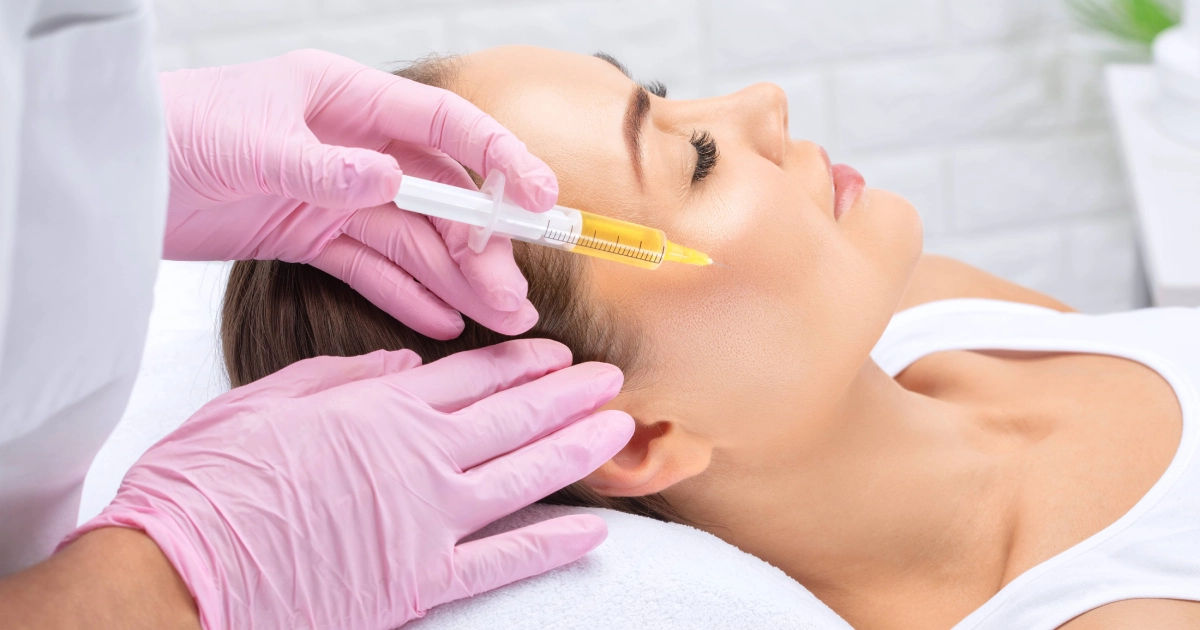
Platelet-Rich Plasma (PRP) — it sounds like something from a sci-fi movie, but it’s actually one of the most natural, science-backed treatments in modern aesthetics. Instead of injecting foreign substances, PRP uses your own blood to trigger healing and regeneration. Think of it as giving your skin a wake-up call it can’t ignore.
If you’ve ever wondered how a simple blood draw can lead to firmer, smoother, younger-looking skin, you’re in the right place. In this guide, we’ll break down the science of PRP, explain what happens during a session, and show you why it’s become a go-to treatment for anyone seeking natural rejuvenation.
What’s inside
The Science Behind PRP
PRP stands for Platelet-Rich Plasma. Platelets are tiny cells in your blood that are famous for their role in clotting, but they also contain growth factors — proteins that signal your body to repair damaged tissue and build new collagen.
When you concentrate these platelets and apply them to targeted areas of the skin, you’re essentially giving your body a supercharged dose of its own healing power. The result? Accelerated cell turnover, improved texture, and a visible reduction in fine lines and scars.
Here’s the kicker: because PRP comes from your body, the risk of allergic reaction or rejection is virtually zero. That’s why it’s considered one of the safest, most natural approaches in aesthetic medicine.
How PRP Is Prepared
Ever wonder what happens between the blood draw and the treatment? It’s a straightforward, sterile process:
- Blood draw: A small amount of blood (similar to a routine lab test) is collected from your arm.
- Centrifugation: The sample is placed in a centrifuge, which spins it at high speed to separate the plasma from the red blood cells.
- Isolation: The platelet-rich plasma is carefully extracted, leaving behind the poor-platelet plasma and red cells.
- Activation: In some cases, the plasma is activated with calcium chloride to release growth factors before application.
The entire preparation takes about 15–20 minutes, and the resulting plasma is a golden-colored liquid packed with regenerative potential.

How PRP Rejuvenates Skin
Once the PRP is applied — either through direct injection or via microneedling — the growth factors get to work. Here’s what happens at the cellular level:
- Fibroblast activation: Growth factors stimulate fibroblasts, the cells responsible for producing collagen and elastin.
- Collagen remodeling: New collagen fibers are laid down, filling in fine lines, acne scars, and sun damage.
- Angiogenesis: PRP promotes the formation of new blood vessels, improving skin tone and nourishment.
- Tissue repair: The combined effect is firmer, smoother, more youthful skin — gradually and naturally.
Because PRP works with your biology, results appear gradually over 2–3 months and continue to improve as collagen production peaks. No frozen faces. No unnatural puffiness. Just your skin, but better.

PRP vs. Other Treatments
Let’s see how PRP stacks up against other popular skin rejuvenation options.
| Feature | PRP Therapy | Dermal Fillers | Laser Resurfacing | Chemical Peels |
|---|---|---|---|---|
| How it works | Uses your own growth factors to stimulate collagen. | Injects synthetic substances to fill volume. | Uses light energy to remove outer skin layers. | Applies acids to exfoliate and renew skin. |
| Source | Autologous (your own blood). | Synthetic or donor-derived. | Device-based. | Chemical-based. |
| Best for | Fine lines, acne scars, texture, overall rejuvenation. | Volume loss, deep wrinkles, facial contouring. | Sun damage, pigmentation, deep wrinkles. | Dullness, mild pigmentation, surface texture. |
| Downtime | Minimal (redness for 24–48 hrs). | Minimal to moderate. | Moderate to significant. | Mild to moderate. |
| Risk of reaction | Very low (uses your own plasma). | Possible allergic reaction. | Risk of burns, scarring, pigmentation changes. | Risk of irritation, burns, pigmentation changes. |
| Results timeline | Gradual over 2–3 months. | Immediate. | Gradual over weeks. | Gradual over days to weeks. |
Who Is the Best Candidate?
PRP is suitable for most adults who want a natural approach to skin rejuvenation. You’re likely a great candidate if you:
- Have fine lines, acne scars, or uneven skin texture.
- Prefer a treatment that uses your own biology.
- Want gradual, natural-looking results rather than instant changes.
- Are not pregnant or breastfeeding.
- Don’t have active skin infections or blood disorders.
The best way to know? Schedule a consultation at Elite Chicago Spa. If you’re also considering other rejuvenation treatments, check our PRP treatment in Chicago, IL — we’ll help you decide if PRP is right for you.
- Marx, R. E. (2001). Platelet-rich plasma (PRP): what is PRP and what is not PRP? Implant Dentistry, 10(4), 225–228.
- Anitua, E., et al. (2008). Autologous platelets as a source of proteins for healing and tissue regeneration. Thrombosis and Haemostasis, 100(1), 4–15.
- Leo, M. S., et al. (2015). Systematic review of the use of platelet-rich plasma in aesthetic dermatology. Journal of Cosmetic Dermatology, 14(4), 315–323.
- American Society for Dermatologic Surgery (ASDS). Platelet-rich plasma (PRP) for skin rejuvenation. Accessed 2026.
These references support the efficacy of PRP for collagen remodeling and skin rejuvenation.
Frequently Asked Questions
Glow Up Your Skin
Don’t let fine lines, scars, or dullness define your confidence. At Elite Chicago Spa, we offer a natural, effective path to smoother, firmer skin with advanced PRP therapy. Our expert team is dedicated to helping you look and feel your best with personalized care in a luxurious, comfortable setting.
Ready to restore your skin naturally and reveal your best self? Schedule a consultation today. Let us help you on your journey to renewed confidence.
Restore Your Skin Naturally – Schedule Your PRP Consultation
Disclaimer: This content is for informational purposes only and does not constitute medical advice. Individual results may vary. Please consult with a qualified healthcare professional for personalized treatment recommendations.